Hard drives need to store more data without continuously increasing in physical size. One way to increase capacity is to shrink the magnetic bits on the platter. As these bits become smaller, however, they become more difficult to write reliably while remaining stable over time.
HAMR overcomes this limitation by briefly heating a small region of the recording medium during a write operation. Heat temporarily makes the magnetic material easier to change, so the drive can use highly stable magnetic media while maintaining a high recording density.
This guide explains how HAMR works, from the physics behind localised heating to the laser, Near-Field Transducer, recording media, and other components involved in the write process.
What Is HAMR?
Heat-Assisted Magnetic Recording (HAMR) is a hard drive writing method that uses a focused laser pulse to heat a small area of the disk surface. This brief heating lowers the medium's coercivity, allowing the write head to change the magnetic state of the heated area. Once the area cools, its magnetic stability increases again. This allows HAMR drives to use magnetic materials with higher coercivity, which can remain stable at smaller grain sizes.
Why Was HAMR Developed?
Hard drives store data using tiny magnetised regions on spinning platters. As areal density increases, the magnetic grains used to record data become smaller, and smaller grains are more vulnerable to thermal fluctuations. At a certain scale, thermal energy can disrupt their magnetic state, a behaviour associated with the superparamagnetic limit.
Stability can be improved with materials that have higher coercivity, which measures resistance to changes in magnetisation. Higher coercivity makes small magnetic grains more stable, but it also makes them more difficult to write. A conventional write head has limits on the magnetic field it can produce, creating a difficult balance between stability and writability. Recording density also depends on signal quality and noise levels, and smaller grains can make it more difficult to maintain an adequate signal-to-noise ratio.
HAMR addresses this problem through localised heating during the write process. The recording medium can have high coercivity under normal conditions, and a heat pulse temporarily reduces that coercivity during writing, allowing the write head to switch the magnetic state. Cooling then restores the medium's higher magnetic stability.
What Is the Physics Behind Heat-Assisted Recording?
HAMR media commonly uses iron-platinum (FePt).
- FePt has high magnetic anisotropy, a property that helps maintain magnetic stability at small grain sizes.
- Every magnetic material has a Curie temperature, above which long-range magnetic order is lost.
- HAMR does not need to heat the medium beyond its Curie temperature. It heats the recording area to a temperature close to the required operating range.
- At these temperatures, the medium's coercivity falls sharply for a short period, allowing the write head to reorient the magnetic state.
The heating event occurs on a short timescale.
- In HAMR, the thermal pulse is typically around a nanosecond.
- The laser, NFT, write head, and control electronics must operate in precise synchrony.
- The heated area must also remain highly localised.
- Excessive heating or poor timing can increase thermal interference with nearby recording regions, making precise control critical to reliable writing.
What Are the Core Components of a HAMR Drive?
HAMR achieves its precise heating and writing process through a set of specialised components working together.
| Component | Role |
|---|---|
| Laser Diode | Generates the heat pulse |
| Near-Field Transducer (NFT) | Focuses light below the diffraction limit onto a nanoscale spot |
| Waveguide | Delivers laser energy from the diode to the NFT |
| High-Ku (FePt) Media | Heat-sensitive, thermally stable magnetic layer |
| Heat Sink Layer | Manages rapid post-write cooling |
HAMR hard drives retain the basic platter-and-head architecture of conventional hard drives, with additional components that generate and deliver localised heat to the recording medium.
The Near-Field Transducer is particularly important in this design. Ordinary optics cannot focus light below the diffraction limit of the light source, yet HAMR requires a much smaller thermal spot on the recording medium. The NFT solves this by using near-field optical effects to concentrate energy locally. The component is positioned extremely close to the spinning disk surface, so it experiences repeated thermal cycling during operation.
How Does a HAMR Write Operation Happen?
A HAMR write involves several closely timed physical events.
- The write head moves to the target location on the platter.
- The laser produces a short optical pulse.
- The waveguide directs optical energy towards the NFT.
- The NFT concentrates that energy onto a nanoscale region.
- The localised heating temporarily reduces the medium's coercivity.
- The write head changes the magnetic state of the heated region.
- The heated area cools and regains its magnetic stability.
The cooling stage is important because the thermal footprint must be kept under control. A Heat Sink Layer helps move heat away from the recording region, limiting unwanted thermal effects in neighbouring areas. The timing between heating and magnetic writing must also remain precise, since the write field needs to act while the medium has suitable magnetic properties.
What Manufacturing and Engineering Challenges Does HAMR Face?
HAMR's underlying physics has been studied for many years, but manufacturing the technology reliably at scale has proven more difficult.
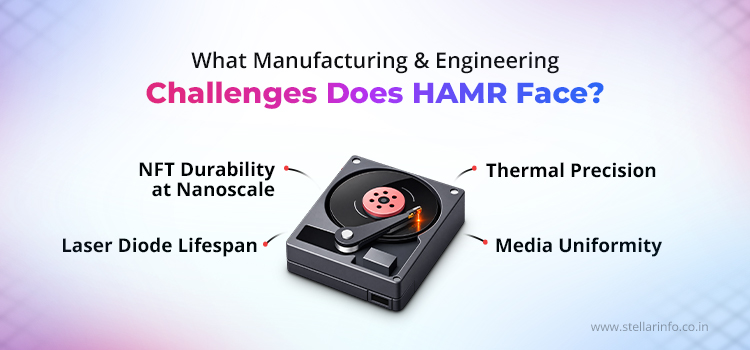
NFT Durability at Nanoscale
The NFT operates under demanding thermal conditions during repeated writes, and its structure must withstand extensive thermal cycling without significant deformation. Even small changes could affect the size or position of the thermal spot.
Laser Diode Lifespan
The laser operates throughout the drive's service life, so its output must remain stable over long periods. The component must also operate reliably inside the sealed drive enclosure.
Thermal Precision
The heat pulse and magnetic write field must be carefully aligned, since timing, head positioning, and disk rotation all affect where the thermal spot reaches the medium. Small variations can affect the accuracy of the recording process, which is why tight control is required across several components.
Media Uniformity
HAMR media needs consistent magnetic and thermal properties across the platter. Variations in grain characteristics can change the response to localised heating, so manufacturers need tight control over the media's composition and structure.
Who Is Building and Deploying HAMR Drives?
HAMR adoption varies by manufacturer, with each taking a different pace towards commercial deployment.
- Seagate currently leads commercial HAMR deployment, with its Mozaic platform aimed largely at hyperscale cloud providers and enterprise storage customers, environments that place strong emphasis on storage density and power efficiency.
- Western Digital is developing HAMR products for large-scale storage applications.
- Toshiba is taking a more gradual approach to HAMR adoption.
Consumer availability remains limited compared with conventional HDD technology, and current HAMR development is focused mainly on high-capacity enterprise and data-centre storage.
What Causes Logical and Physical HAMR Drive Failure?
HAMR drives can experience both logical and physical failures, and the recovery approach depends on the type and extent of the failure.
What Is a Logical HAMR Drive Failure?
A logical failure affects access to stored data rather than the drive's physical components, and the drive may still be detected by the operating system or storage controller. Common causes include file system corruption, accidental formatting, partition damage, malware, or interrupted write operations. In such cases, the recording media may remain physically intact.
A professional recovery process begins with a controlled assessment of the drive to determine whether the media can be read safely. If the drive remains stable, specialists may create a sector-level image of the storage media. Recovery is then performed from the image rather than the original drive, reducing unnecessary stress on the source media, and the recovered image can be analysed for file-system structures, partitions, and available user data.
What Is a Physical HAMR Drive Failure?
Physical failure involves damage to the drive's hardware or recording mechanism. Possible symptoms include non-detection, unusual noises, repeated spin-up attempts, or complete loss of drive operation. The damage can affect the PCB, spindle motor, read/write heads, or other internal components. HAMR also adds specialised components for optical heating, including the laser, waveguide, and Near-Field Transducer, and damage to these can affect the drive's ability to perform normal read and write operations.
The drive should not be opened outside a controlled Cleanroom environment, since dust particles can contaminate the platter surface and create additional damage. This is particularly important when internal components need to be accessed.
Conclusion: Recovering Data from a Failed HAMR Drive
The right recovery approach depends entirely on how the drive failed. A logical failure calls for a controlled image of the drive, from which file-system structures can be reconstructed and accessible data extracted. A physical failure is a different matter altogether, demanding an ISO-certified Class 100 Cleanroom, specialist repair of damaged components, and, where necessary, compatible donor parts. Either way, the original media is never worked on directly. Every step of recovery happens from an image, which means no further risk is taken.
HAMR drives raise the stakes further, with a laser, waveguide, and Near-Field Transducer that demand experienced, precise handling the moment something goes wrong. Stellar Data Recovery has that experience across logical, electronic, and mechanical HAMR failures, built on years of working with the most advanced recording technologies on the market. Get in touch today for a professional assessment before a fixable failure becomes permanent data loss.
To learn more about HDD recording technologies and data recovery, explore these related guides covering HAMR vs MAMR vs SMR vs CMR, SMR recovery, CMR vs SMR drives, and helium-filled hard drives.
FAQs
The laser heats a very small area of the platter to a temperature at which its coercivity falls considerably. The actual temperature depends on the recording medium and the design of the drive. There is no need to heat the whole platter to its Curie temperature.
The laser does not come into physical contact with the platter. Its light is carried through a waveguide to the Near-Field Transducer, which is placed very close to the recording surface.
HAMR heats a small part of the medium with a laser, a waveguide, and a Near-Field Transducer. This lowers coercivity while data is being written. MAMR uses a microwave field produced near the write pole instead, and it does not need a laser or an optical path.
HAMR drives have been aimed mostly at enterprise and data-centre use. They are not yet sold for regular desktop computers or home NAS systems.
HAMR media is designed to cope with repeated heating and cooling during normal use. The laser and the Near-Field Transducer also need to last through a large number of cycles. For this reason, these two parts play a major role in deciding how reliable a HAMR drive will be over the long term.


About The Author

Professional Content Writer and Analyst