Every hard drive eventually runs out of room, and the way manufacturers solve that problem shapes everything from how a drive performs to how difficult it is to recover if it fails. CMR, SMR, HAMR, and MAMR are the four recording technologies behind that progress, and the right choice depends on the workload. Frequent random writes are best handled by CMR. High-capacity backup and archival needs are better served by SMR. HAMR and MAMR, in turn, are built for the enterprise and data-centre systems that require the highest capacity per drive.
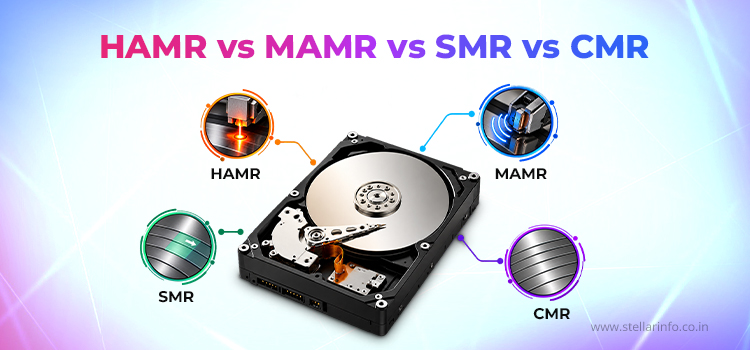
Here is a closer look at how each one works, what sets them apart, and what that difference means when a drive eventually fails.
Why Do Hard Drives Need New Recording Technologies?
As areal density increases, physical and engineering limits become more difficult to manage. Magnetic grains must remain stable enough to retain data, and the write head must still be able to change their magnetic state reliably.
Higher density involves more than placing tracks closer together, which is why manufacturers have developed several recording approaches.
- CMR and SMR differ in how they arrange data tracks.
- MAMR and HAMR use write-assistance techniques to support higher recording densities.
- Overlap between technologies is possible, which is why they are better treated as related approaches than as sequential generations.
What Is Conventional Magnetic Recording (CMR)?
Conventional Magnetic Recording (CMR) stores data on separate, non-overlapping tracks on the platter. Guard spaces between tracks reduce interference, allowing each track to be written and updated independently. That is what makes CMR a reliable choice for workloads with frequent random writes.
CMR is often discussed alongside Perpendicular Magnetic Recording (PMR), though the two describe different aspects of a drive. CMR refers to the arrangement of tracks, while PMR refers to the orientation used for recording. Many modern CMR HDDs use PMR.
How Does CMR Work?
A CMR HDD writes each track separately, keeping neighbouring tracks unaffected. The process follows five steps.
- Spin. The platter spins at a fixed speed.
- Position. The actuator moves the head over the required track.
- Write. The write head changes the magnetic orientation of the recording medium.
- Isolate. Data is written to a dedicated track without overlapping adjacent tracks.
- Map. The drive firmware maps logical block addresses to physical locations on the media.
This non-overlapping layout simplifies random write operations compared with shingled designs.
What Are the Advantages of CMR?
The track-by-track design gives CMR several practical strengths.
- Random and mixed workloads. Individual tracks can be updated without touching neighbouring ones.
- Predictable write behaviour. Performance stays fairly consistent under varied workloads.
- No shingled rewrite management. The drive does not need to buffer and rewrite overlapping tracks.
- Broad compatibility. CMR works with most operating systems and storage systems.
- General-purpose fit. It is a common choice for performance-sensitive storage.
These strengths explain why CMR remains a standard option for everyday and professional storage.
What Are the Limitations of CMR?
CMR's main limitation is how far areal density can be increased. Non-overlapping tracks and guard spaces limit how much data fits in a given area, and as tracks shrink to close this gap, thermal stability, writability, signal quality, and reliable head-media interaction all become more difficult to maintain.
This limit is the main reason SMR, HAMR, and MAMR were developed.
Where Is CMR Used?
CMR is commonly found in the following.
- Personal and professional computing. Desktop computers and workstations.
- Shared and server storage. NAS systems and servers.
- Everyday storage needs. General-purpose storage, especially workloads with frequent random writes.
In essence, CMR suits any setup where consistent write performance matters more than maximum capacity.
What Is Shingled Magnetic Recording (SMR)?
Shingled Magnetic Recording (SMR) increases areal density by partially overlapping adjacent data tracks. The concept resembles roof shingles, where each new track overlaps part of the previous track rather than leaving a full guard space. This allows more tracks to be stored in a comparable physical area.
How Does SMR Work?
A conventional write head is typically wider than the final width of each track. SMR uses this characteristic to write tracks in an overlapping pattern.
- A wider write head records a track.
- The next track is written partially over the previous one.
- The process continues until a shingled band of tracks is formed.
- Individual tracks can still be read, because the read element is narrower than the write head.
The advantage is higher areal density. The trade-off appears when existing data must be updated. Changing one track can affect neighbouring tracks that were partially overwritten. Depending on the drive design, the firmware may need to buffer data and perform additional reads and rewrites.
What Are the Types of SMR?
SMR implementations are commonly grouped into three categories.
- Drive-Managed SMR (DM-SMR) has firmware that manages the shingled regions internally. The host interacts with the drive much as it would with a conventional block device.
- Host-Aware SMR lets the host detect that the drive uses SMR and adjust its workload. The drive still handles a substantial part of the management.
- Host-Managed SMR makes the host responsible for following the drive zoning requirements. Writes to sequential-write-required zones must follow the rules defined by the applicable storage standards.
What Are the Advantages of SMR?
SMR's overlapping design trades some write flexibility for extra capacity, which brings several benefits. The main ones are listed below.
- Higher areal density.
- Greater storage capacity in a comparable physical footprint.
- A reasonable option for capacity-focused storage.
- Good suitability for sequential workloads.
These advantages explain why SMR remains a popular choice for high-capacity, low-turnover storage.
What Are the Limitations of SMR?
The overlapping tracks that raise capacity also create trade-offs, mainly in how data is updated.
- Additional write-management overhead.
- Lower and less predictable performance for random or mixed writes, particularly when the drive reorganises data within its shingled regions.
- Longer rebuild times in some NAS and RAID environments, because rebuilds generate heavy write activity.
These trade-offs matter most for workloads with frequent, unpredictable writes.
Where Is SMR Used?
SMR suits environments where data is written in large sequential batches and rarely modified afterwards.
- Backup storage
- Archival systems
- Cold data
- Large sequential datasets
- Capacity-oriented storage environments
SMR is a weaker match for workloads that frequently modify small blocks of data.
What Is Heat-Assisted Magnetic Recording (HAMR)?
Heat-Assisted Magnetic Recording (HAMR) uses localised heat to enable writing data to a highly stable magnetic medium. As recording grains shrink, they must stay magnetically stable, allowing stored data to resist thermal effects. A more stable medium, however, is more difficult for a conventional write head to change. HAMR addresses this by temporarily lowering the medium's coercivity during the write operation.
How Does HAMR Work?
A HAMR drive uses a laser-based optical system, including a Near-Field Transducer (NFT), to heat a very small area of the recording medium. The general process is listed below.
- The write head moves to the target location.
- The laser generates a highly localised heat source.
- The NFT concentrates the optical energy onto a tiny area of the platter.
- The heated region becomes easier to magnetise for a brief period.
- The write head changes the magnetic state of the heated area.
- The area cools quickly and returns to a stable magnetic state.
The heating occurs over a short interval, generally on the order of nanoseconds.
What Are the Advantages of HAMR?
HAMR allows manufacturers to use smaller, more stable magnetic grains without losing writability.
- Supports higher areal density.
- Enables the use of highly stable magnetic media.
- Offers a path to increasing HDD capacity over time.
- Can be paired with non-overlapping track layouts.
Together, these strengths make HAMR a leading route to higher-capacity drives.
What Are the Limitations of HAMR?
HAMR adds optical and thermal components to the recording system, which increases design complexity.
- Requires specialised media and a more intricate recording head assembly.
- Depends on the laser, the NFT, and the thermal behaviour of the recording system working reliably at small physical scales.
- Adds engineering complexity compared with conventional recording approaches.
That added complexity is the main reason HAMR drives remain concentrated in enterprise and data-centre use.
Where Is HAMR Used?
HAMR is primarily associated with high-capacity enterprise and data-centre HDDs, where increasing capacity per drive is most important.
What Is Microwave-Assisted Magnetic Recording (MAMR)?
Microwave-Assisted Magnetic Recording (MAMR) uses a microwave field to assist the write process. It does not heat the recording medium with a laser. A component called a Spin-Torque Oscillator (STO) generates a localised microwave field near the write head. This field makes it easier for the write head to change the magnetic state of the recording medium.
How Does MAMR Work?
The MAMR write process follows the steps listed below.
- The write head moves over the required location.
- The Spin-Torque Oscillator generates a microwave field.
- The microwave field assists the magnetic switching process.
- The write head records the required data.
- The magnetic medium retains the recorded state after writing.
MAMR does not rely on the laser and localised heating used by HAMR.
What Are the Advantages of MAMR?
MAMR improves writability without adding laser-based heating to the recording system.
- Supports higher recording density.
- Avoids the need for laser-based heating.
- Can retain a non-overlapping track layout.
- Offers another route to improving writability.
These advantages position MAMR as a lower-complexity alternative to HAMR for raising capacity.
What Are the Limitations of MAMR?
MAMR depends on a precisely engineered microwave component within the write head, which imposes additional design demands.
- Requires specialised head and media engineering.
- Needs the Spin-Torque Oscillator to operate reliably inside a tightly controlled recording system.
- Depends in practice on the specific drive architecture and recording generation.
Such demands mean MAMR adoption varies by manufacturer and drive generation.
Where Is MAMR Used?
MAMR has been developed mainly for high-capacity enterprise and data-centre HDD applications.
HAMR vs SMR vs CMR vs MAMR: Comparison
The table below compares CMR, SMR, HAMR, and MAMR by working method, key component, heating requirement, track layout, strengths, limitations, and typical use.
| Technology | How It Works | Key Component | Heating Required | Track Layout | Advantage | Limitation | Typical Use |
|---|---|---|---|---|---|---|---|
| CMR | Conventional magnetic writing | Conventional write head | No | Non-overlapping | Good random-write behaviour | Further density scaling becomes increasingly challenging | Desktop, NAS, servers, general storage |
| SMR | Tracks are partially overlapped | Conventional write head, wider than each track | No | Shingled | Higher areal density | Additional write management can affect random-write performance | Backup, archival, sequential workloads |
| HAMR | Localised heating assists magnetic writing | Laser and Near-Field Transducer | Yes | Can be non-overlapping | Supports higher recording density | More complex laser, NFT, and thermal engineering | Enterprise and data-centre storage |
| MAMR | Microwave field assists magnetic writing | Spin-Torque Oscillator | No | Can be non-overlapping | Supports higher recording density | Specialised head and media design | High-capacity enterprise and data-centre storage |
Does Recording Technology Affect Data Recovery?
Recording technology can affect data recovery, but it is only one part of the picture. The recovery approach depends mainly on the failure. A damaged HDD may have problems with the heads, platters, firmware, electronics, service area, or logical structures. The recording method can add another layer of complexity.
How Does CMR Affect Data Recovery?
CMR's independent track layout can make some physical and logical recovery tasks more straightforward.
- A CMR drive can still suffer severe head, platter, firmware, or electronic damage.
- In such cases, the failure type largely decides the recovery approach.
How Does SMR Affect Data Recovery?
SMR's overlapping tracks call for additional consideration during recovery.
- A problem in one area can affect neighbouring tracks or shingled bands.
- Recovery may require specialised techniques to interpret the recorded data and accurately reconstruct the affected areas.
How Do MAMR and HAMR Affect Data Recovery?
MAMR and HAMR drives use specialised head and media technologies, so engineers may need to account for the specific recording architecture.
- The approach varies with the drive model, failure type, firmware condition, and state of the recording media.
- Physical damage requires specialised handling and controlled procedures to prevent further damage to the media.
Why Should Damaged HDD Recovery Be Left to Professionals?
A professional data recovery expert plays an important role when a hard drive has physical or logical damage.
- Prioritise recovery. Data recovery should be prioritised before a drive is sent for warranty replacement or handed over for servicing. Once the drive leaves, the chance to retrieve its data may be reduced or lost entirely.
- Use a Cleanroom. A physically damaged hard drive typically needs to be opened and stabilised inside an ISO-certified Class 100 Cleanroom. This environment keeps airborne particles very low and protects exposed internal components from contamination.
- Work from a clone. Once damaged parts are addressed and the drive is stable, specialists clone it and continue from the resulting image. The original media is not used directly.
- Avoid overwriting. Working from a clone lets professionals recover data without touching the original media. Downloadable software is unlikely to reproduce this result on a physically damaged drive, and attempting to do so can increase the risk of overwriting recoverable data.
Stellar Data Recovery uses an ISO-certified Class 100 Cleanroom for physical HDD recovery, along with specialised equipment and procedures suited to damaged storage media.
Wrapping Up: Final Word on CMR, SMR, HAMR, and MAMR
Choosing between these technologies comes down to the workload, not which one is newest. CMR suits frequent random writes, SMR suits backup and archival needs, and HAMR and MAMR exist mainly to push enterprise and data-centre capacity further. For data recovery, the recording technology provides context, but the failure mode carries more weight, whether it is physical damage, firmware issues, or logical corruption. The safest step for a failing HDD is to stop using it, since repeated restarts, CHKDSK, and downloadable software can overwrite data a professional could otherwise recover.
Stellar Data Recovery has the expertise to recover data from CMR, SMR, MAMR, and HAMR drives, whatever the recording technology or the extent of the damage. Physical failures are handled inside an ISO-certified Class 100 Cleanroom, using specialised equipment and controlled procedures designed for this exact kind of recovery.
Every hour a failing drive keeps running is an hour closer to permanent data loss. Get in touch with Stellar Data Recovery now for a free evaluation, and give your data the best possible chance of recovery.
For a deeper understanding of HDD technologies and recovery challenges, explore these related guides covering SMR data recovery, CMR vs SMR drives, and helium-filled hard drives.
SMR Hard-Drive Data Recovery: A Complete Guide for Owners
CMR vs SMR Hard Drives: Which One Should You Pick
Helium-Filled Hard Drives: How They Work and Why Recovery is Challenging
FAQs
No. CMR refers to the arrangement of data tracks, where tracks do not overlap. PMR refers to the orientation used for magnetic recording. Many modern CMR HDDs use PMR.
The answer depends on the workload. CMR is generally better suited to frequent random writes, because individual tracks can be updated independently. SMR is useful when high capacity and sequential workloads are the priority.
No. However, the overlapping track structure can add complexity to some recovery and reconstruction tasks.
The recording technology is not usually printed on the drive label. Checking the manufacturer's datasheet or product specification for the exact model number is the most reliable way to confirm it, as manufacturers specify the recording type there.
There is no universal answer. MAMR uses microwave assistance, and HAMR uses localised laser heating. Both technologies support higher recording densities, but they use different engineering approaches.


About The Author

Professional Content Writer and Analyst