Summary: In forensic investigations, the reliability of evidence depends entirely on how it was collected. Many investigators underestimate how quickly things can go wrong. A single background process running on an unprotected system is all it takes to alter timestamps, overwrite files and quietly compromise the integrity of an entire acquisition without leaving any obvious trace.
Write blockers prevent this by intercepting write commands before they reach the source device. This blog covers their function, their application in forensic imaging and disk cloning, standard acquisition protocols and how Stellar Forensic Toolkit supports a legally defensible investigation.
In forensic investigations, the acquisition stage is where cases are won or lost. Accessing a suspect drive without the proper safeguards can alter timestamps, overwrite deleted files and introduce inconsistencies that are difficult to substantiate under cross-examination.
A write blocker resolves this by operating as a controlled interface between the suspect drive and the forensic workstation, intercepting write commands issued by the operating system and ensuring the original evidence remains unmodified throughout the acquisition process.
Understanding how they work and where they fit is what separates a defensible investigation from a compromised one.
What Problems Occur Without a Write Blocker?
Preserving the integrity of digital evidence is one of the most demanding aspects of forensic investigation, and the risk begins earlier than most anticipate. When a storage device is connected to a Windows workstation without adequate protection, the operating system does not wait. Hidden files are generated on the drive, antivirus software runs background scans and indexing processes modify access timestamps, all of this happens automatically, without any instruction from the investigator.
Without a write blocker in place, forensic investigators face the following risks:
- Modification of original evidence
- Accidental deletion or corruption of files
- Alteration of access timestamps
- Contamination of metadata
- Changes in file allocations
- Loss of evidentiary reliability
- Challenges of legal admissibility in court
If the defence can demonstrate that the acquisition process lacked adequate safeguards, the integrity of the evidence cannot be guaranteed and the admissibility of the entire case becomes open to challenge.
Write blockers eliminate that vulnerability. In a professional forensic environment, they are not an optional safeguard but a fundamental requirement, ensuring that the evidence collected at acquisition remains identical to what is presented in court.
How Can Investigators Detect Evidence Alteration?
The hash value of digital data serves as its unique fingerprint. Cryptographic functions such as MD5, SHA-1 and SHA-256 allow investigators to determine with absolute certainty whether evidence has been altered at any point during the acquisition process.
Common indicators of evidence alteration include:
- Mismatched hash values between source and image files
- Modification of file timestamps
- Unexpected metadata entries
- Changes in file records
- Gaps in chain of custody documentation
- Corrupted or inaccessible forensic images
A hash mismatch is never coincidental. It is a direct indication of one of the following:
- Accidental modification
- Deliberate evidence tampering
- Imaging errors
- Hardware failure
It is worth noting that hash verification is only reliable when the original evidence has been adequately protected from the outset. Post-imaging verification cannot compensate for an acquisition process that lacked the protection of a write blocker.
How Do Write Blockers Protect Digital Evidence?
Write blockers serve as a controlled interface between the suspect storage device and the forensic workstation. They prevent write operations from reaching the source media while allowing the investigator to read and copy data without restriction.
How a Write Blocker Works
When a storage device is connected to a workstation, the operating system automatically initiates background write operations. A write blocker intercepts these commands before they reach the original device, ensuring the source evidence remains unmodified throughout the examination process.
Types of Write Blockers
There are two categories of write blockers used in digital forensics:
| Type | Description |
|---|---|
| Hardware Write Blocker | A physical device placed between the suspect drive and the forensic workstation |
| Software Write Blocker | A software based solution that restricts write access through operating system controls |
Why Are Write Blockers Essential During Forensic Imaging?
Forensic imaging refers to the creation of a bit-for-bit copy of a storage device. Unlike standard file duplication, forensic imaging captures active files, deleted files, unallocated space, hidden partitions and file system metadata and registries.
A write blocker ensures that the imaging and cloning process adheres to forensically sound protocols and digital forensic procedures. Write blocker-based acquisition procedures are supported by professional forensic imaging tools.
Stellar Forensic Toolkit assists investigators in performing precise imaging and evidence acquisition while preserving data integrity. Prior to and following the imaging process, investigators generate hash values. Matching both hash values confirms that the forensic image is an exact, unaltered duplicate of the source media.
What Are the Steps in a Forensic Imaging Workflow?
A forensically sound imaging process follows a clear, documented sequence that leaves no room for ambiguity:
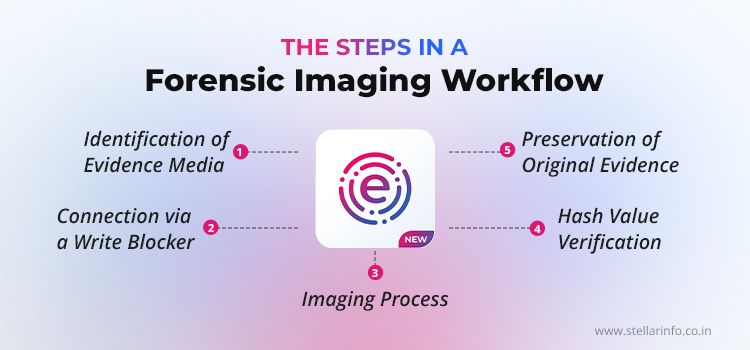
- Identification of Evidence Media — Record the storage device details including model, serial number, capacity and physical condition. This establishes the foundation of the chain of custody before anything else begins.
- Connection via a Write Blocker — Connect the device to the forensic workstation using a hardware or software write blocker. This ensures the source device remains protected from the moment it is accessed.
- Imaging Process — Deploy specialised forensic software such as the Stellar Forensic Toolkit to capture file structures, metadata and all evidentiary data residing on the device.
- Hash Value Verification — Generate and compare hash values before and after imaging. Matching values confirm that the process introduced no modification to the source evidence.
- Preservation of Original Evidence — Once imaging is complete, seal the original device and store it securely. All subsequent examination is conducted exclusively on the forensic image.
Why Are Write Blockers Essential During Disk Cloning?
Unlike forensic imaging, which produces an image file, disk cloning creates a physical duplicate of the source drive that can be booted and examined as an independent device. The objective is absolute fidelity to the original, and that standard begins with how the source drive is handled.
During cloning, forensic software conducts a sector-by-sector transfer from the source to the destination drive, encompassing:
- Operating file system
- User data
- Deleted files
- Partition structures
- Boot records
- File system metadata
- Unallocated space
Any interference with the source drive during this process, whether from OS background activity or an unprotected connection, can alter boot records, corrupt file system metadata, modify access logs and compromise partition structures before a single sector has been verified.
A write blocker eliminates that interference entirely. It ensures the source drive remains in its original state from the first sector read to the last, producing a destination drive that is a precise, unquestionable replica of the evidence.
What Is the Difference Between Forensic Imaging and Disk Cloning?
While both processes create a copy of the original storage device, they serve different purposes and produce different outputs.
The table below outlines the key distinctions:
| Feature | Forensic Imaging | Disk Cloning |
|---|---|---|
| Output Format | Image file (E01, RAW, AFF) | Physical duplicate drive |
| Storage Method | Stored as a forensic image file | Stored on another disk |
| Compression Support | Often supported | Usually not supported |
| Metadata Preservation | Preserved | Preserved |
| Bootable Copy | Not always | Often yes |
| Common Usage | Evidence analysis | System recovery and replication |
Regardless of which process is used, the requirement for a write blocker remains the same. The source device must remain unaltered throughout, and no duplication method changes that standard.
What Happens During Imaging Without a Write Blocker?
The consequences of imaging without a write blocker extend across every aspect of a forensic investigation. The comparison below illustrates what is at stake:
| Feature | With Write Blocker | Without Write Blocker |
| Evidence Integrity | Preserved | Risk of alteration |
| Hash Consistency | Maintained | May change |
| Metadata Protection | Secure | Vulnerable |
| Court Admissibility | Stronger | Potentially challenged |
| Risk of Data Modification | Minimal | High |
| Forensic Reliability | High | Compromised |
Each of these factors carries direct legal and professional consequences. In a forensic environment where evidence is subject to rigorous scrutiny, the absence of a write blocker is not a calculated risk. It is an unacceptable one.
What Are the Best Practices for Using Write Blockers?
A write blocker is only as effective as the process surrounding it. Regardless of the investigation, the following standards should be observed without exception:
- Verify the write blocker is functioning correctly before connecting any device
- Document the serial number, make, model and capacity of all devices involved
- Generate and verify hash values both before and after acquisition
- Use validated forensic imaging software throughout the process
- Never mount evidence directly on the workstation
- Maintain detailed chain of custody records at every stage
- Store the original evidence securely once acquisition is complete
These are not procedural formalities. They are the standards by which the credibility of an investigation is measured, and any deviation from them, however minor, can be sufficient to undermine the integrity of the evidence in court.
Why Write Blockers Remain Non-Negotiable in Digital Forensics
The integrity of digital evidence is determined at the point of acquisition. Before imaging commences and before any analysis takes place, the decisions made in those initial moments determine whether the evidence withstands or fails under legal scrutiny.
Write blockers are what make those decisions defensible. They are not an added precaution but a baseline requirement for any investigation conducted to a professional standard.
Stellar Forensic Toolkit is built with that requirement at its core. Write blocker based acquisition workflows and hash-confirmed forensic images ensure that every piece of evidence collected is verifiable, reliable and court-ready.
The strength of an investigation begins with how evidence is collected. Make sure that process is one you can stand behind.
Reinforce your forensic acquisition process with Stellar Forensic Toolkit. Contact our experts today to find out how we can support your investigation.
You may also find these articles helpful for understanding the broader role of digital forensics and storage analysis in modern investigations:


About The Author

Digital Forensic Specialist & Analyst