Forensic carving is an important component of digital investigations aimed at recovering data from NAS and RAID systems. Because data within a RAID system is striped across multiple drives, investigators must first reconstruct the RAID configuration, including the RAID level, disc order, stripe size, and parity, before file carving can be performed. Recovering deleted files from a NAS or RAID system differs considerably from recovering them from a standard hard drive, which is why this form of forensic data recovery requires a dedicated process.
This proves particularly significant in cases involving ransomware attacks, insider threats, financial fraud, data breaches, and cybercrime, where accurate forensic data retrieval and the preservation of digital evidence integrity are paramount. Forensic professionals managing complex NAS and RAID recovery cases generally prefer Stellar Toolkit for Data Recovery to conventional file recovery tools.
Three questions shape the rest of this guide: how RAID systems organise data, what causes that data to disappear, and how investigators recover evidence from raw storage once it does.
Key Highlights:
- Forensic carving is the extraction of deleted or inaccessible files directly from raw storage.
- RAID reconstruction must be completed before file carving can begin.
- Emails, databases, and surveillance footage are frequently stored on NAS devices and often contain business-critical evidence.
- Forensic tools tailored for the task improve recovery accuracy and preserve evidence integrity.
- Professional recovery software such as Stellar Toolkit for Data Recovery should be used to recover damaged or complex RAID arrays.
Why Is Forensic Carving Important in NAS and RAID Investigations?
Forensic carving is the process of searching raw binary data in storage devices for known file signatures, headers, footers, and internal structures, rather than searching for filenames or directory entries. Investigators can build files directly from disc sectors, making this form of forensic file recovery effective even when evidence would otherwise be considered permanently lost.
Forensic carving offers an effective way to recover evidence while preserving forensic integrity and supporting legal admissibility for law enforcement agencies, corporate investigators, and incident response teams.
Whenever data is deleted or corrupted, some of the original data is often left in the storage medium. Forensic carving is not based on directory information but on raw disc data to identify and recover files.
What Causes Data Loss in NAS and RAID Systems?
Several factors can render data stored in NAS and RAID environments inaccessible, and identifying which one has occurred helps investigators determine the most effective course of action for recovery.
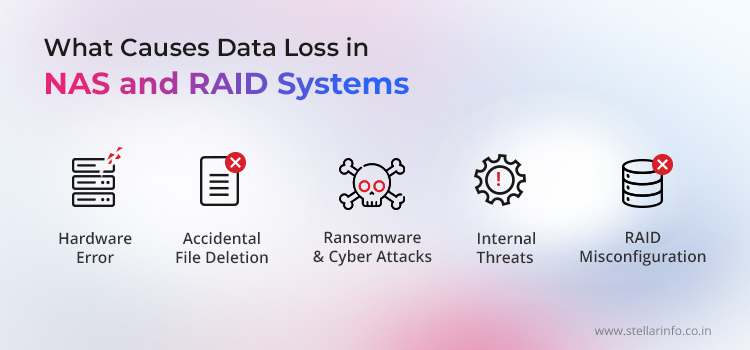
- Hardware Error: Hard drives can fail from mechanical wear and tear, bad sectors, power surges, overheating, and certain manufacturing defects. RAID controllers, cables, and power supplies can also fail, preventing access to stored data.
- Accidental File Deletion: Critical business files can disappear in seconds after accidentally deleting a shared folder or formatting the wrong volume. Forensic carving is a useful recovery technique here, as traces of the original data often remain on storage media until they are overwritten.
- Ransomware and Cyber Attacks: NAS devices are frequent targets for ransomware groups, largely because they store centralised business data. Such attacks often involve encrypting storage, deleting backups, and, at times, even altering the RAID configuration to make recovery considerably more difficult.
- Internal Threats: When an employee leaves an organisation or acts with fraudulent intent, sensitive information may be deliberately deleted, altered, or hidden. Such situations necessitate the retrieval of deleted evidence for in-house investigations and legal proceedings.
- RAID Misconfiguration: A RAID array can become inaccessible due to an incorrect RAID rebuild, replacement of a drive out of order, a change in the RAID controller's settings, or accidental initialisation of a healthy RAID array.
What Are the Signs That Forensic Carving May Be Required?
The forensic carving technique is useful when conventional recovery methods cannot find or restore files. Typical indicators include:
- Files or folders disappear without any warning, even when storage capacity remains available
- A RAID failure renders the NAS volume inaccessible
- The file system is corrupted or unreadable
- Regular recovery software cannot recover deleted files
- A RAID rebuild fails or returns incomplete data
- Storage metadata has been damaged by malware or ransomware
- Investigators suspect evidence has been deliberately deleted or concealed
- Files are fragmented or partially overwritten on storage devices
These situations often indicate that the file system can no longer provide sufficient information for recovery, and only forensic carving can perform such raw data analysis.
Understanding NAS: The Foundation of Modern Enterprise Storage
Network Attached Storage (NAS) is a storage device connected to a network that provides access to data for multiple users and devices from a central location. Unlike external hard drives, a NAS system is a standalone device with its own operating system, processor, memory, and storage management software.
Organisations of all sizes have embraced NAS solutions to streamline file sharing, automate backups, facilitate remote collaboration, and boost data availability. Examples of the type of business data typically stored on NAS devices include:
- Financial statements
- Personnel records
- Customer databases
- Security camera footage
- Emails and correspondence
- Virtual machine images
- Software repositories
- Project files and shared folders
Because NAS systems frequently contain high-value information for multiple users, they are often primary sources of digital evidence in cybercrime investigations, insider threat cases, intellectual property theft, and regulatory audits.
Most enterprise NAS devices do not rely on a single hard drive. They use multiple drives arranged in a RAID configuration instead, which can improve performance and reliability, but also adds another layer of complexity for investigators trying to recover deleted evidence. Before investigators can recover deleted or damaged files, they must first understand how the RAID array stores and organises data.
The next section covers RAID architecture, explains different RAID levels, and examines why reconstructing a RAID array is the first and most important step before performing forensic carving.
What Is RAID Architecture?
RAID (Redundant Array of Independent Disks) is a storage technology that uses two or more physical drives to appear as one logical drive. Data is distributed across disks using striping, mirroring, or parity, depending on the RAID level in use. RAID provides redundancy in the event of hardware failure, as well as increased storage capacity and performance.
RAID increases data availability but also increases the complexity of forensic investigations. A standalone hard drive stores an entire file on one disc, whereas a RAID array splits a file into blocks stored across multiple drives. Depending on the RAID level, parity information may also be stored to help reconstruct data in the event of a drive failure.
As a result, investigators cannot examine a single disc in isolation. For any meaningful forensic analysis or file carving to take place, every drive in the RAID array must first be acquired, preserved, and reconstructed in the correct order.
How Does RAID Store Data?
RAID stores data using the following methods:
- Striping: This method divides data into smaller segments and distributes them across multiple disks, allowing multiple drives to read and write simultaneously, which significantly improves performance. In a RAID 0 array, however, the failure of a single drive can result in the loss of the entire dataset, since fragments of every file are spread across the array.
- Mirroring: Every piece of data written to one disc is copied simultaneously to the other, providing the array with a built-in backup. This benefits investigators as well, since mirrored drives help preserve evidence, although both copies should still be checked to confirm they match and that neither has been altered.
- Parity: This refers to additional information derived from the original data blocks and distributed across the array. When a drive fails, the RAID controller uses this information to rebuild the lost data rather than duplicating entire files. It strengthens the array's resilience, but also makes forensic reconstruction harder, since investigators must correctly determine the parity calculations and disc layout before forensic data recovery can even begin.
Common RAID Levels Used in NAS Devices
Different RAID levels make different trade-offs between performance, storage efficiency, and fault tolerance. Understanding these configurations assists investigators in making the appropriate reconstruction decision.
| RAID Level | Data Organization | Fault Tolerance | Performance | Common Use Cases |
|---|---|---|---|---|
| RAID 0 | Striping | None | Very High | Temporary storage, high-speed workloads |
| RAID 1 | Mirroring | One disk per mirroring | Moderate | Critical business files and backups |
| RAID 5 | Striping with distributed parity | One disk failure | High | Small and medium-sized business NAS systems |
| RAID 6 | Striping with double parity | Two disk failures | High | Enterprise storage and archival systems |
| RAID 10 | Mirroring + Striping | Multiple failures (depending on configuration) | Very High | Databases, virtualisation, enterprise applications |
Since each RAID level stores data differently, investigators must correctly identify the array configuration before attempting forensic recovery.
Why RAID Reconstruction Is Necessary Before File Carving
One mistake investigators sometimes make is attempting to recover files before rebuilding the RAID array. Forensic carving carried out before RAID reconstruction often yields incomplete, corrupted, or unusable files.
To reconstruct the original storage environment, investigators need to determine several key RAID parameters:
- RAID level
- Number of physical hard discs
- Disc sequence
- Stripe size
- Parity offset
- Parity rotation (RAID 5 and RAID 6)
- Controller-specific metadata
The first step in the investigation is to take forensic images of each drive in the RAID array, allowing investigators to work on exact copies whilst leaving the original evidence untouched. For this reason, RAID reconstruction is considered one of the most critical stages in a forensic investigation.
How Does Forensic Carving Work on NAS and RAID Systems?
Once the RAID array image has been successfully reconstructed, the forensic carving process can begin. Traditional recovery uses the file system to identify and restore deleted files. Forensic carving, in contrast, scans raw storage for recognisable patterns that indicate the presence of deleted or damaged files. The process typically involves the following stages.
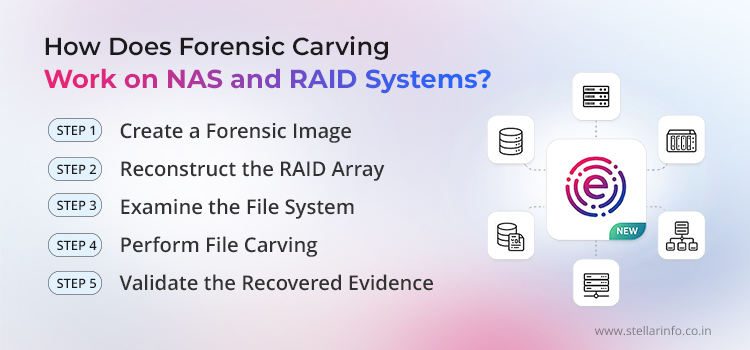
Step 1: Create a Forensic Image
A bit-for-bit imaging process is used to acquire all physical drives in the RAID array. Imaging preserves the original evidence, allowing investigators to work on forensic copies without compromising the integrity of the source media. Hash values are computed before and after imaging to verify that the data has not been altered during acquisition.
Step 2: Reconstruct the RAID Array
Forensic software reconstructs the original logical storage by determining the correct RAID parameters. This reconstructed array serves as the working copy for subsequent analysis.
Step 3: Examine the File System
Investigators rarely rely on a single carving technique. Depending on the condition of the storage media, approaches are combined to maximise recovery. Where sufficient metadata is available, conventional recovery methods are attempted first. When metadata has been corrupted or lost, investigators proceed directly to raw data analysis.
Step 4: Perform File Carving
File carving searches for known file signatures and binary structures within the reconstructed storage. It identifies patterns specific to a file type rather than relying on directory entries or file names.
Commonly recovered file types include:
- Microsoft Office files
- PDF files
- JPEG and PNG images
- ZIP and RAR archives
- Videos
- Emails
- Databases
- VM files
- Log files
Where possible, usable files are reconstructed from recovered fragments.
Step 5: Validate the Recovered Evidence
After recovery, investigators verify the integrity of recovered files using cryptographic hash values. This verification is carried out at every stage of the recovery process to maintain a clear chain of custody and ensure that recovered evidence is reliable and admissible in court.
What Are the Common File Carving Methods Used in Digital Forensics?
Several forensic carving techniques are used depending on the condition of the storage media and the availability of metadata.
| File Carving Method | How It Works | Best Used For |
|---|---|---|
| Signature-Based Carving | Searches for known file headers and footers | Images, PDFs, Office documents |
| Header-Footer Carving | Uses file start and end markers | Sequential, non-fragmented files |
| Structure-Based Carving | Identifies internal file structures | Complex file formats and databases |
| Fragment-Based Carving | Reassembles scattered file fragments | Highly fragmented storage |
| Metadata-Assisted Carving | Combines remaining metadata with raw data | Partially damaged file systems |
Why Professional Data Recovery Software Matters
Restoring data from NAS and RAID systems requires significantly more expertise than restoring files from a single hard disc. Incorrect recovery attempts, improper RAID rebuilding, or accidental overwriting can permanently reduce the chances of successful evidence recovery.
Professional recovery software provides advanced features such as:
- RAID parameter auto-discovery
- Virtual RAID reconstruction
- Support for corrupted file systems
- Advanced file carving algorithms
- Recovery of formatted or inaccessible storage
- Preview of recoverable files before recovery
For organisations managing business-critical data or digital evidence, these capabilities can dramatically improve recovery outcomes and reduce operational risk.
Recovering data from a corrupted RAID array goes beyond simply retrieving deleted files. Investigators often need to identify the RAID configuration, virtually rebuild the array, and verify recovered evidence. Completing these steps manually is time-consuming and increases the risk of errors.
How Does Stellar Toolkit for Data Recovery Support NAS and RAID Recovery?
Stellar Toolkit for Data Recovery, widely regarded as the best forensic data recovery software for complex NAS and RAID cases, helps recover RAID parameters, restore inaccessible data, and rebuild damaged arrays while minimising the risk of further data loss. The software supports automatic RAID reconstruction and is compatible with RAID 0, RAID 5, and RAID 6 configurations. It can also rebuild a logical RAID and apply advanced scanning techniques to locate deleted or lost files. Stellar Toolkit for Data Recovery additionally supports recovery of all data types from inaccessible or failed NAS devices.
These capabilities prove valuable when recovering business documents, databases, multimedia files, virtual machine data, and other mission-critical information stored in enterprise environments. For organisations that have experienced cyber incidents or significant data loss, Stellar Toolkit for Data Recovery is an effective way to minimise downtime and improve recovery efficiency.
Key Takeaways
- Forensic imaging first: Always create a forensic image before any recovery or analysis.
- Reconstruct before carving: Rebuild the RAID configuration before attempting file carving.
- Match method to condition: Use appropriate carving methods for corrupted or fragmented files.
- Maintain chain of custody: Record cryptographic hash values at every stage of the process.
- Preserve original evidence: Do not rebuild or modify the original RAID array until forensic copies have been secured.
- Use professional tools: Use professional recovery software or services for complex RAID failures or business-critical investigations.
Conclusion: Recovering Digital Evidence from NAS and RAID Systems
NAS devices and RAID arrays form the foundation of modern business storage, but recovering critical data from these systems presents unique challenges that conventional recovery methods cannot handle. Whether data loss stems from accidental deletion, hardware failure, ransomware, or insider activity, forensic carving provides investigators with a reliable method to retrieve evidence that would otherwise remain inaccessible.
Successful forensic recovery from NAS and RAID environments depends on following a structured process, using the right tools, and preserving evidence integrity at every stage. Stellar Forensic Toolkit is built to handle this complexity, offering automatic RAID reconstruction, advanced file carving, and support for failed or inaccessible NAS devices.
For professional assistance with NAS or RAID data recovery, contact Stellar Data Recovery at 1800-102-3232.
Explore more on forensic carving techniques, NAS recovery, and digital evidence preservation in the related articles below:
- Understanding Hard Drives and RAM: Structure, Function, and Forensic Importance
- What is Forensic Science? Definition, Evolution and the Rise of Digital Forensics in India
- Why Write Blockers Are Important in Forensic Imaging and Cloning
- What Are Hidden Storage Areas? Understanding HPA, DCO, and ROM in Forensic Investigation
- How to Recover Data from a Failed NAS Device
FAQs
Yes. If the deleted data has not been overwritten, forensic carving techniques can often recover files directly from the underlying storage media. The success of recovery depends on several factors, such as RAID configuration, file fragmentation, and the condition of the storage devices.
No. RAID improves data availability and fault tolerance, but is not a substitute for a backup strategy. If data is accidentally deleted, hit with ransomware, corrupted, or otherwise deliberately attacked, the entire RAID array can be lost.
Yes. One of the benefits of forensic carving is that it operates on raw storage sectors, not just file system metadata. This enables investigators to recover files even when directory structures or allocation tables have been deleted or corrupted.
Recovery depends on the condition of the storage devices and the type of failure. There is no single answer. RAID 1 is generally simpler because it uses mirrored copies of the data. RAID 5 and RAID 6 generally require more complex data reconstruction because they involve parity calculations.
Yes. Stellar Toolkit for Data Recovery offers solutions for recovering data from various RAID configurations and NAS storage devices. Depending on the product edition and storage environment, users can recover deleted, formatted, or inaccessible data without affecting the integrity of the original storage.
In most cases, once data has been overwritten, it cannot be recovered because it has been replaced by new data. But if only part of the file has been overwritten, forensic carving can still recover recoverable fragments or partially reconstruct the original file.


About The Author

Digital Forensic Specialist & Analyst