Key Takeaways
- Evidence preservation precedes forensic imaging, which in turn precedes RAID reconstruction, metadata analysis, deleted file recovery, and, where necessary, forensic carving. This is the sequence investigators generally follow when working with a NAS device.
- NAS devices carry significant investigative value largely because of what they store: business documents, emails, databases, surveillance footage, virtual machine files, and system logs, material on which most cybercrime and incident-response cases depend.
- Neither a RAID failure nor a ransomware attack determines, on its own, whether data can be recovered. That outcome depends on whether proper forensic procedure is followed and the original storage remains unaltered.
- Stellar Data Recovery for NAS is designed for these more complex cases, simplifying RAID reconstruction and enabling recovery from volumes that are inaccessible or corrupted, without compromising data integrity.
A NAS device can lose access to business-critical data within minutes. Ransomware, accidental deletion, RAID failure, file system corruption, hardware malfunction, and insider activity are among the common causes. In most cases, the data remains physically present on the storage media even after it becomes inaccessible. This is what makes NAS devices such a valuable source of digital evidence in cybercrime investigations, incident response, corporate enquiries, and legal proceedings.
NAS data recovery in a forensic context involves considerably more than restoring deleted files. Investigators follow a defined forensic process, beginning with preservation of the storage media, followed by forensic imaging, RAID reconstruction, and analysis of file system metadata. The method applied depends on the nature of the incident. Metadata-based recovery is generally suited to deleted files, whereas forensic carving, which reads data directly from a drive's raw sectors, becomes necessary when file system information is corrupted or missing.
Complex RAID arrays and advanced file systems make these recoveries notoriously difficult. Stellar Data Recovery for NAS supports investigators through this process, reconstructing RAID configurations, recovering data from inaccessible or corrupted volumes, and retrieving files from major NAS platforms, all without compromising data integrity.
Why Are NAS Devices Important in Digital Investigation?
NAS devices store business documents, surveillance recordings, emails, backups, databases, and system logs, often for dozens of users at once. This is what makes them a core source of digital evidence. An investigator called into a cyber incident, an insider case, a ransomware attack, or a legal dispute will typically start by examining NAS storage to reconstruct what happened and pull out anything deleted or hidden from view. The original data has to remain untouched throughout the process, which is why forensic techniques matter as much as the tools used.
NAS devices are frequently involved in investigations related to:
- Insider threats and data breaches
- Ransomware and cybercrime incidents
- Financial investigations and corporate fraud
- Theft of intellectual property
- Accidental data loss or deletion
- Security breach and malware investigations
- Regulatory compliance and eDiscovery
- Recovery of digital evidence for legal purposes
How Do Digital Investigators Recover Evidence From NAS Devices?
To recover evidence from NAS devices, investigators must undertake considerably more than scanning for deleted files. NAS systems frequently have multiple drives configured in RAID. Before carving can begin, investigators must first preserve the original data and recreate the storage environment. Below is a typical workflow for NAS forensic carving.
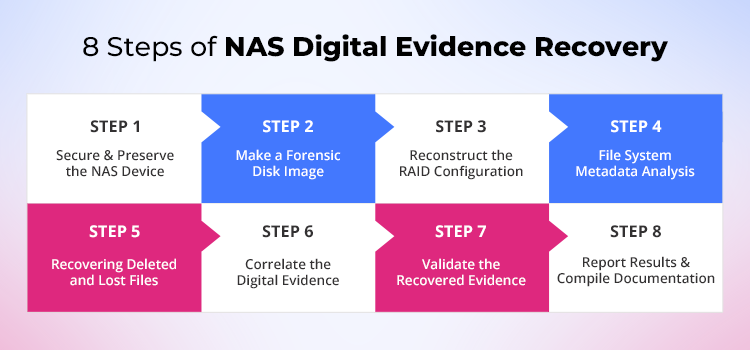
Step 1: Secure and Preserve the NAS Device
The priority is maintaining the integrity of the evidence. Any unnecessary activity on the NAS could overwrite deleted data, reducing the chances of successful recovery.
Investigators usually:
- Prevent further writes
- Document the storage configuration
- Disconnect the NAS from the network if the situation warrants it
- Record the drive order, RAID level, and system information
- Maintain proper chain of custody
Keeping the original evidence unaltered helps ensure the investigation can be legally defended and remains reliable.
Step 2: Make a Forensic Disk Image
Investigators create a forensic image of each disk on a bit-by-bit basis rather than analysing the original storage drives directly.
Unlike a normal backup, a forensic image copies every sector on the drive, including:
- Open files
- Deleted files
- Unallocated space
- Slack space
- Hidden partitions
- System metadata
Using a forensic image protects the original evidence. It also allows the investigator to repeat or verify findings without altering the source data.
Step 3: Reconstruct the RAID Configuration
Many NAS devices rely on RAID to improve performance and provide redundancy. RAID data recovery in this context starts with correctly rebuilding the array configuration. Depending on the device, investigators may need to determine:
- RAID level (RAID 0, RAID 1, RAID 5, RAID 6, and RAID 10)
- Disk sequence
- Stripe width
- Parity rotation
- Offset values
Restoring the RAID configuration incorrectly results in incomplete or corrupted recovered files, which is why proper RAID reconstruction remains a vital part of any NAS forensic investigation.
Step 4: File System Metadata Analysis
Investigators check directory structures, timestamps, user permissions, audit logs, snapshots, and allocation records to determine user activity and identify whether evidence was deleted or modified. Metadata analysis often makes recovery possible without the need for file carving.
Step 5: Recovering Deleted and Lost Files
Metadata-based recovery is generally the first method investigators attempt, the specific approach depending on the condition of the storage in question. Where directory entries have been lost or damaged, a more advanced technique becomes necessary: forensic carving, which recovers files directly from raw storage sectors.
Step 6: Correlate the Digital Evidence
Reconstructing a timeline and identifying user actions require cross-correlating all recovered data: documents, emails, databases, logs, surveillance footage, and system artefacts. It is this process of correlation, rather than recovery on its own, that ultimately underpins the wider investigation.
Step 7: Validate the Recovered Evidence
Recovering a file is only the first step. Investigators also need to confirm that the recovered data is genuine, complete, and usable as evidence.
Validation typically involves:
- Opening recovered files
- Verifying file integrity
- Confirming file structure
- Comparing cryptographic hash values
- Checking that the recovered content fits the needs of the investigation
This helps ensure the recovered evidence holds up for forensic analysis or legal proceedings.
Step 8: Report Results and Compile Documentation
Every stage of a forensic investigation needs to be documented clearly enough that the process can be reviewed and verified independently.
A forensic report typically includes:
- Device details and storage configuration
- Method used to acquire the forensic image
- Original RAID configuration and how it was reconstructed
- Recovery methodology and tools used
- Types of files recovered
- Outcome of the validation process
- Cryptographic hash values
- A timeline of the investigation
Complete documentation ensures transparency and enhances the credibility of digital evidence.
What Are the Investigation Techniques Used on NAS Devices?
Digital investigators use several forensic techniques to recover, analyse, and validate evidence stored on a NAS. The technique used depends on the type of incident, the condition of the storage media, and the availability of file system metadata.
| Technique | Purpose |
|---|---|
| Forensic Imaging | Creates a bit-by-bit copy of the NAS drives while preserving the original evidence. |
| RAID Reconstruction | Rebuilds damaged or inaccessible RAID arrays to restore access to stored data. |
| Metadata Analysis | Examines file timestamps, permissions, logs, and directory structures to establish user activity and timelines. |
| Deleted File Recovery | Restores deleted files using available file system metadata and recovery records. |
| Forensic Carving | Recovers files directly from raw storage sectors when metadata is missing or corrupted. |
| Keyword and Artefact Search |
Identifies relevant documents, emails, logs, and other digital evidence using targeted searches. |
| Hash Verification | Confirms the integrity and authenticity of recovered evidence using cryptographic hash values. |
Professional tools such as Stellar Data Recovery for NAS can assist with RAID rebuilding and data recovery in cases of damaged RAID arrays, inaccessible NAS volumes, or corrupt file systems, allowing investigators to retrieve important evidence before proceeding to detailed forensic analysis.
What Are the Common Challenges in Recovering Digital Evidence From NAS Devices?
NAS investigations centre on distributed storage systems, network access, and storage systems for businesses, which are different from those related to independent storage devices. Some specific issues need to be solved during the investigation process.
- Complex RAID Architectures: NAS units generally employ RAID 5, RAID 6, RAID 10, or proprietary RAID configurations like Synology Hybrid RAID (SHR). It is challenging to reconstruct a RAID configuration due to missing drives, an incorrect drive sequence, missing stripe size information, or corrupted parity information.
- Proprietary Storage Formats and File Systems: Many NAS vendors use advanced file systems (Btrfs, EXT4, ZFS, or proprietary formats). Misinterpreting metadata, snapshots, and allocation structures may result in incomplete or inaccurate evidence recovery.
- Snapshot and Version Control: Most NAS devices now automatically create snapshots and retain version histories. These features preserve historical evidence but require investigators to separate active files, deleted data, and multiple historical versions of the same document.
- Encryption and Access Control: Enterprise NAS environments often use encrypted volumes, encrypted shared folders, secure authentication, and role-based access permissions. Without the correct credentials or encryption keys, investigators may struggle to access evidence.
- Large Storage Capacity: Enterprise NAS appliances can store tens or hundreds of terabytes of data. Scanning, imaging, reconstructing, and validating such large storage environments requires considerable time and resources.
- Network-Based Acquisition: Unlike standalone hard drives, NAS devices are network-attached and may receive new writes during an investigation. Investigators must isolate the system to preserve volatile information and prevent contamination of evidence.
- Ensuring Legal Admissibility: Every action taken during acquisition and recovery must preserve data integrity. Failure to document procedures, maintain chain of custody, or verify evidence using cryptographic hash values can affect the admissibility of digital evidence.
Best Practices for Recovering Evidence from NAS Devices
Recovering evidence is more successful and reliable when established forensic procedures are followed.
- Keep the original NAS environment intact. Wherever possible, investigators should avoid examining the original storage directly. Creating a forensic image of each drive allows the examination to proceed without disturbing the original evidence.
- Record the RAID configuration before disassembly. Before removing any drives, the RAID level, drive order, serial numbers, controller settings, firmware version, and storage configuration should be recorded. Minor documentation errors can complicate RAID reconstruction.
- Work only on forensic copies. All recovery, reconstruction, and analysis should be carried out on forensic images or cloned drives, not on the original storage media.
- Verify every step with cryptographic hashes. Hash values should be generated before acquisition and after recovery to confirm that evidence has not been modified during the investigation.
- Validate recovered evidence. Recovered files should be opened, checked for completeness, and correlated with metadata, logs, and timestamps before being included in investigation reports.
- Keep full records. Investigators should document acquisition methods, software versions, RAID reconstruction parameters, recovery techniques, validation results, and all actions taken during the investigation to support transparency and legal defensibility.
- Use professional recovery solutions for difficult cases. Specialised recovery software that offers RAID reconstruction and forensic-grade recovery improves accuracy and reduces the risk of accidental data modification when working with broken RAID arrays, inaccessible NAS volumes, or corrupted file systems.
Why Professional Data Recovery Software or Experts May Be Needed
NAS recovery becomes more complicated once advanced storage technologies, multiple file systems, and varied RAID configurations enter the picture, and this is usually the point where professional NAS data recovery services become essential. Dedicated recovery software removes much of the difficulty involved when a device becomes inaccessible due to RAID failure, accidental deletion, corrupted firmware, or a file system error.
- Broad file system and brand support. Stellar Forensic Toolkit for Data Recovery supports BTRFS, EXT4, NTFS, APFS, HFS+, and exFAT, and works with major NAS brands including Synology, QNAP, and ASUSTOR.
- RAID data recovery. RAID-based NAS systems fall within its scope, spanning RAID 0, 1, 5, 6, and 10, with the toolkit reconstructing the array virtually from whatever parameters remain available for RAID data recovery. The original configuration does not need to be complete or unaltered for this to work.
- Two recovery paths. Online recovery applies to NAS devices that remain accessible over the network, while offline recovery is designed for drives removed and connected directly to a Windows computer.
- Advanced scanning for harder cases. Standard recovery methods do not always succeed in complex NAS data-loss scenarios. Stellar Forensic Toolkit relies on file-signature-based recovery for precisely these cases, retrieving documents, photographs, videos, email files, databases, and other critical data while maintaining data integrity throughout the process.
Conclusion: Why Stellar Toolkit for Data Recovery Matters for Recovering Evidence from NAS
Network attached storage (NAS) devices have become a necessity for organisations and individuals who need centralised, reliable, and scalable storage. Important files can become inaccessible due to accidental deletion, ransomware, RAID failures, hardware problems, and file system corruption.
Recovering evidence from NAS devices requires more than simply restoring deleted files. Digital investigators must preserve the original data, reconstruct RAID configurations, analyse file system metadata, recover deleted files, perform forensic carving as needed, and validate the recovered evidence to ensure its integrity and admissibility. A structured forensic workflow increases the likelihood that valuable information will be recovered and that the investigation will remain reliable.
In situations such as RAID failures, file system corruption, inaccessible NAS volumes, or accidental data loss, professional recovery solutions can greatly simplify the investigation process. Stellar Toolkit for Data Recovery supports virtual RAID reconstruction, recovery from corrupted or damaged NAS storage, and advanced scanning and retrieval of a wide range of file types from leading NAS platforms. Its combination of powerful recovery capabilities and forensic best practices helps investigators quickly recover critical digital evidence while preserving the integrity of the original data.
Get in touch with Stellar data recovery experts to discuss the right approach for a NAS recovery or forensic investigation.
From understanding how file systems fail to knowing exactly when forensic-grade recovery becomes essential, there's always more to learn about protecting and retrieving critical data, so take a moment to browse the related reads below and stay one step ahead.
FAQs
Yes, deleted files can often be recovered if they have not been overwritten. Investigators generally begin with metadata-based recovery and resort to forensic carving to recover files directly from raw storage sectors if necessary.
Investigators first reconstruct the RAID configuration by identifying parameters such as RAID level, disk order, and stripe size. After the array is reconstructed, they can analyse the file system, undelete files, and extract digital evidence. Stellar Data Recovery for NAS simplifies RAID reconstruction and data recovery.
Depending on the state of the storage media, investigators may recover documents, emails, images, videos, databases, system logs, virtual machine files, backups, and other digital artefacts relevant to an investigation.
Professional recovery software is warranted when RAID fails, the file system becomes corrupted, files are accidentally deleted, firmware issues arise, or hardware problems occur. Tools such as Stellar Data Recovery for NAS are useful for recovering data while maintaining the integrity of the original storage.
Forensic imaging creates a bit-for-bit copy of the storage media, allowing investigators to analyse and recover evidence without changing the original data. This preserves the integrity of the evidence and supports legally defensible investigations.


About The Author

Digital Forensic Specialist & Analyst