Summary:
HPA (Host Protected Area), DCO (Device Configuration Overlay), and ROM (Read-Only Memory) are hidden storage regions that a standard operating system cannot access. Built for legitimate purposes such as system recovery, firmware storage, and device configuration, these areas have since been exploited by threat actors to conceal malware, rootkits, and stolen data in locations that conventional security tools were never designed to examine.
For incident responders and forensic examiners, hidden storage regions are not something that can be overlooked. This article examines what HPA, DCO, and ROM are, the security risks each presents, how investigators detect them, why mainstream forensic tools frequently fall short when these regions are exploited, and how Stellar's forensic solutions address that gap.
Storage drives have hidden areas that standard operating system commands were never designed to reach. The most common among them are the Host Protected Area (HPA), Device Configuration Overlay (DCO), and Read-Only Memory (ROM). For forensic investigators, these regions represent a genuine blind spot. Standard imaging tools frequently fail to capture them, and the evidence they contain can go undetected throughout the examination.
The scale of the threat makes this a pressing concern. According to Cybersecurity Ventures, the global cost of cybercrime is projected to reach USD 10.5 trillion annually by 2025, placing serious pressure on investigation teams to account for every part of a storage device. Forensic professionals need tools that can actually reach these hidden sectors, not only the portions a drive makes readily available.
Understanding these hidden areas and what it takes to examine them properly is fundamental to any forensic investigation worth its findings.
What Are the Types of Hidden Storage Areas?
Each hidden storage area operates differently, serves a distinct purpose, and brings its own complications to a forensic investigation. The three that matter most are HPA, DCO, and ROM.
The common types of hidden storage areas are:
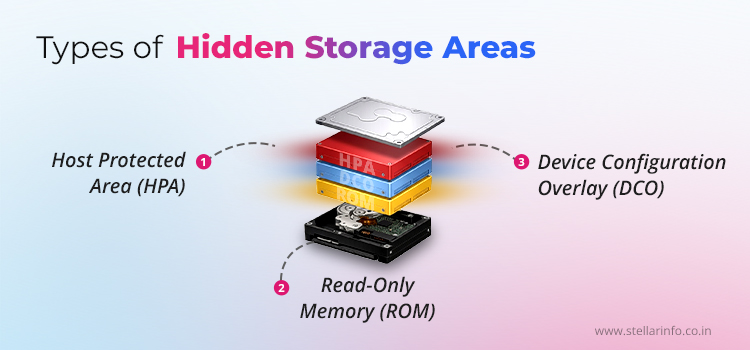
#1 - Host Protected Area (HPA):
HPA refers to the allocated space on a hard drive where information is stored. This area cannot be seen by the operating system because it is not included in the list reported by the computer’s hardware. The information in this area was initially intended to contain system files or recovery tools. However, it also represents a potential hiding place for threat actors.
#2 - Device Configuration Overlay (DCO):
Where HPA conceals a portion of the drive's storage, DCO operates differently. It changes what a storage device reports to the operating system regarding its own capabilities. This includes parameters such as drive size and supported features. Threat actors may exploit DCO to conceal data or alter the reported characteristics of a drive. Because DCO functions at a lower hardware level, it is difficult to detect with standard forensic tools.
#3 - Read-Only Memory (ROM):
ROM differs from HPA and DCO in one fundamental way. It is not a section of storage space that can be hidden or resized. It is a non-volatile memory device that stores the firmware and boot sequence required for the computer to operate before its operating system loads. ROM is rarely used by intruders to store concealed information, which does not mean the memory is irrelevant for digital forensics purposes. The malicious firmware residing in ROM cannot be erased using the usual methods; it will stay alive after OS reinstatement and a complete disk format operation.
HPA vs. DCO vs. ROM: What Are the Differences?
Each of these regions serves a distinct purpose and presents a different set of challenges in a forensic context. The table below outlines the key differences across visibility, function, security risk, and forensic importance.
| Feature | HPA | DCO | ROM |
|---|---|---|---|
| Visibility to OS | Limited | Hidden | Not directly accessible |
| Main Purpose | Recovery | Device configuration | Firmware storage |
| Security Risk | Hidden malware | Concealed data | Firmware manipulation |
| Forensic Importance | High | High | Critical |
HPA and DCO are primarily storage-level concerns, but ROM operates at a fundamentally different level. A threat embedded in firmware does not behave like concealed data. It presents itself as a native component of the device, which makes it the most difficult of the three to detect and remediate.
What Security Risks Do Hidden Storage Areas Introduce?
Hidden storage areas remain invisible to conventional operating systems and standard forensic tools, and that inaccessibility is precisely what threat actors seek to exploit. The sections below outline the three primary ways these regions are misused.
1. Malware Concealment
Threat actors store malicious payloads within HPA or DCO regions because antivirus and endpoint monitoring tools have limited visibility in these regions. Files placed in these locations do not appear during routine security scans, allowing an infection to remain active far longer than it otherwise would. For forensic investigators, this is a significant concern. A device that appears clean on standard examination may still carry active malicious code.
2. Rootkits and Persistence Mechanisms
Hidden storage regions give attackers a place to store rootkits and persistence mechanisms that survive operating system reinstallation. Because these components reside outside the visible file system, wiping and reloading the OS does nothing to remove them. In certain situations, these regions are also used to stage confidential data before it is moved out of the organisation, making them relevant not only to malware investigations but also to data breach cases.
3. Anti-Forensic Techniques
Manipulating HPA or DCO configurations and altering firmware settings are not new tactics. Attackers have used them for years to obstruct forensic work, obscure evidence, and alter how a drive appears to investigative tools. If such hidden sectors were to remain concealed as they are, the investigator might not know that anything is missing at all. Inferences drawn from an analysis with incomplete information are unreliable, and the results could be grave.
Standard forensic tools were never designed for this. They function well within the bounds of what an operating system can see, but hidden sectors lie entirely outside them. When those regions go unexamined, the investigation proceeds without a complete picture of the device, and anything that was not recovered will not appear in the findings. Addressing this requires specialised forensic and data recovery solutions that operate at a level standard software was never intended to reach.
How Do Investigators Detect Hidden Storage Regions?
Detecting hidden storage regions requires forensic techniques that operate below standard operating system interfaces. The following methods are the most relevant to identifying and accessing HPA, DCO, and firmware-level storage during an investigation.
1. Hardware-Based Acquisition
Forensic investigators use hardware-based acquisition to access storage devices directly, without the operating system acting as an intermediary. Rather than working with the logical view the OS presents, this approach allows investigators to interact with the physical drive. That distinction matters when hidden regions need to be identified and imaged, and it also reduces the risk of evidence being altered during acquisition.
2. Forensic Disk Analysis Tools
One of the more telling signs of a hidden storage region is a discrepancy between a drive's actual physical size and the capacity reported by the operating system. Advanced disk analysis tools compare these two figures and flag inconsistencies that may point to HPA or DCO. They can also surface hidden partitions, inaccessible sectors, and configuration anomalies that a standard examination would never reveal.
3. Firmware Inspection
Firmware inspection has become an increasingly important part of investigations involving persistent threats. Investigators look for unusual modifications or code that does not match the manufacturer's original configuration. Because firmware operates below the file system, changes at this level are invisible through conventional examination methods. When ROM manipulation is suspected, dedicated firmware analysis is not optional.
4. Write Blockers
Write protectors, both hardware and software types, prevent writing to the hard drive during acquisition. That way, there would be no chance of any alteration to the content of the drive during examination. Forensic imaging, through a bit-by-bit process, produces a hash that is then compared with the original to verify the integrity of the evidence obtained. Otherwise, any evidence taken from hidden partitions will not be reliable or admissible in court.
No single acquisition method is sufficient when hidden storage regions are involved. Each technique outlined here addresses a different layer of the device, and a thorough forensic examination requires employing all of them when HPA, DCO, or ROM exploitation is suspected.
Advanced Forensic and Data Recovery Solutions in Digital Investigations
Digital evidence may not always be retrievable using traditional forensic methods. Hidden storage areas, corrupt media, and inaccessible sectors call for specialised data recovery tools in order to conduct a proper investigation. The sections that follow provide insight into situations in which traditional tools are ineffective.
Where Standard Tools Fall Short
Standard utilities and basic imaging software work within the limits of what an operating system can see. Storage regions that fall outside those limits are not captured during routine acquisition, which means a device's forensic record can be incomplete before the examination has properly begun.
What an Incomplete Acquisition Costs an Investigation
When hidden storage regions go unexamined, the investigation proceeds on an incomplete picture of the device. Data that was never retrieved cannot be analysed, and conclusions drawn from a partial acquisition are difficult to substantiate under scrutiny. In a field where the integrity of findings can determine the outcome of legal proceedings, that is not a risk any investigation can afford to carry.
Why Evidence Integrity Cannot Be Compromised
Any tampering with the data during acquisition will render it either inauthentic or inadmissible. This is because the processes used should be able to access the hidden parts without modifying their contents.
What Specialised Solutions Provide
Forensic and data recovery solutions such as Stellar Data Recovery are engineered to operate where standard tools reach their limit. By scanning below the operating system level, identifying concealed sectors, and retrieving data from storage regions that conventional imaging software cannot access, they ensure that a forensic acquisition reflects the device's complete state.
Conclusion: Hidden Storage Is Where Evidence Hides — Stellar Helps You Find It
HPA, DCO, and ROM were built for legitimate purposes. In the hands of a threat actor, they become the parts of a storage device that a standard investigation will never reach. Malware, rootkits, and exfiltrated data stored in these regions do not surface during routine forensic imaging, and an examination that does not account for them is incomplete.
For forensic investigators, the standard of evidence required in legal proceedings leaves no room for an incomplete acquisition. Every region of a storage device must be examined, documented, and verified. Achieving that standard requires solutions built specifically for the task.
Stellar Data Recovery provides forensic investigators with the depth of analysis needed to identify concealed sectors, access hidden storage regions, and retrieve data that conventional tools cannot reach. Where standard acquisition stops, Stellar continues.
If your investigation involves storage devices where hidden regions may have been exploited, speak with Stellar's forensic experts to discuss your recovery and acquisition requirements.
To further explore digital forensics, evidence acquisition, and advanced storage analysis techniques, you may find these related articles useful:
FAQs
HPA conceals a portion of the drive from the operating system. DCO, by contrast, alters the reported configuration and capabilities of the drive, changing how it presents itself to the system entirely.
Data in hidden areas such as HPA and DCO is completely inaccessible if forensic investigators fail to locate it. The entire forensic analysis will be based on incomplete information, and any findings from this analysis could be misleading.
Forensic imaging entails replicating a computer's hard disk from one location to another as a duplicate, preserving the original data. Unlike general data replication, forensic imaging involves capturing everything on the hard drive, regardless of whether it can be viewed or accessed normally.
Hidden storage sectors such as HPA and DCO can be found using forensic software and hardware. The simplest way to determine this is to compare the hard disk's actual size with the size shown by the operating system. If there is a difference in these two sizes, it means that some storage is hidden.
Stellar Data Recovery aids forensic investigations by identifying hidden storage areas from which data can be recovered from inaccessible storage devices after a detailed investigation.
Indeed. Threat actors can use HPA or DCO areas to hide malware, persistence, and other compromised data. Because such areas cannot be accessed by standard operating systems and analysis tools, the process becomes very complicated.


About The Author

Digital Forensic Specialist & Analyst